
 Arms of the City of Thunder Bay
Arms of the City of Thunder Bay
Blazon
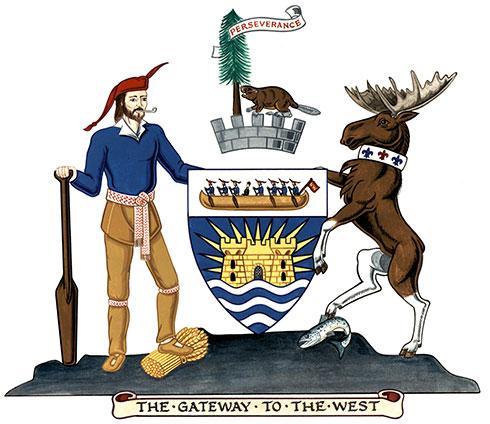
Azure a castle irradiated, its portcullis raised Or, issuant from three bars wavy, on a chief Argent a birchbark canoe therein a European man and seven Canadian voyageurs the latter with their paddles in action proper, in the stern a flag Gules inscribed NW in letters Or;
Symbolism
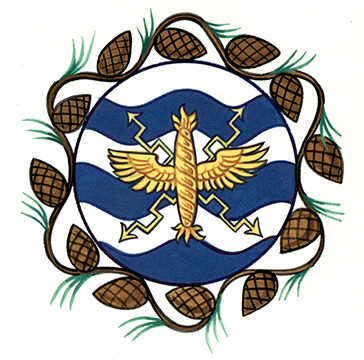
The Canadian Heraldic Authority does not have confirmed symbolism for this emblem. The following comments are hypotheses only. The castle emerging from waves is taken from the historic arms of Port Arthur, which merged with Fort William to create the City of Thunder Bay in 1970. The gateway reflects Port Arthur’s historical role as the eastern terminus of the Canadian Pacific Railway, while the water alludes to the fact that it was a port city that also served as a major transshipment location for the Great Lakes. The canoe is taken from the arms of Fort William and uses elements from an attributed coat of arms for the North West Company, a notable fur-trading enterprise, and the arms granted to William McGillivray, the city’s namesake and the last chief partner of the Company.
Crest of the City of Thunder Bay
Blazon
A beaver gnawing at the trunk of a pine tree proper the branches thereof enfiled by a scroll Argent bearing the word PERSEVERANCE in letters Gules, all issuant from a mural crown proper;
Symbolism
This is the crest granted to the City of Fort William, which used the beaver, tree and scroll with the word “Perseverance” from the crest of William McGillivray. The mural crown is often used to identify a municipality.
Motto of the City of Thunder Bay
Blazon
THE GATEWAY TO THE WEST;
Symbolism
This phrase alludes to the symbolism of the Arms.
Supporters of the City of Thunder Bay
Blazon
Dexter a voyageur holding a paddle proper his foot resting on a garb fesswise Or, sinister a moose proper gorged with a collar Argent charged with a fleur-de-lis Gules between two fleurs-de-lis Azure resting its hind leg on a salmon, both standing on a representation of the Sleeping Giant mountain proper;
Symbolism
The Canadian Heraldic Authority does not have confirmed symbolism for this emblem. The following comments are hypotheses only. The voyageur is one of the supporters of the arms of Fort William and likely alludes to the city’s history as one of the starting points of the canoe routes to Western Canada, as well as to its status as a fur trading post in the early 19th century. The moose is one of the supporters of the arms of Port Arthur and alludes to the forests and wildlife that surround the area. Its white collar bearing red and blue fleurs-de-lis is based on the label on the coat of arms of the Prince Arthur, Duke of Connaught, after whom the former city of Port Arthur was named. The wheat symbolizes the area’s importance to the grain trade in Canada as the location for numerous silos for the Canadian Pacific and Canadian Northern railways. The salmon possibly refers to the former Port Arthur Hatchery and to the area’s tradition of sport fishing.


