
The contents of this Register are intended for research purposes only. The heraldic emblems found in the Register may not be reproduced in any form or in any media without the written consent of the Canadian Heraldic Authority and/or the recipient.
London, Ontario
Registration of Arms
May 15, 2025
Vol. VIII, p. 378


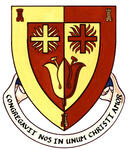
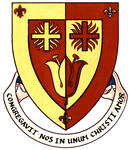
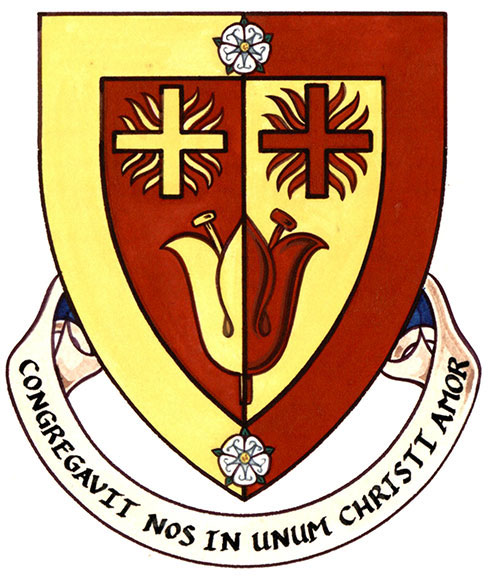
Arms of the Federation of the Sisters of St. Joseph of Canada for use by the Sisters of St. Joseph for the Diocese of Toronto in Upper CanadaBlazonPer pale Gules and Or a lily slipped, in chief two crosses couped and rayonnant, all within a bordure counterchanged charged with two roses in pale Argent barbed and seeded proper; SymbolismThe lily has long been used as a symbol for St. Joseph. The yellow cross represents Christian education and the red cross represents the apostolate of the sick, the two principal mandates of the Federation. The flames surrounding the crosses allude to the Holy Spirit. Red represents Canada, while yellow is a colour associated with the Papacy. The Toronto congregation of the Federation is distinguished by the white rose, the symbol of York, which was the previous name of Toronto. The fact that the Toronto congregation has two rather than three symbols on the border is an indication of its status as the senior congregation in Canada. |
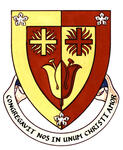
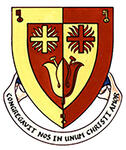
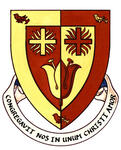
MottoBlazonCONGREGAVIT NOS IN UNUM CHRISTI AMOR; SymbolismThis Latin phrase means “The love of Christ has gathered us.” It is the second line of the ancient hymn “Ubi Caritas,” attributed to St. Paulinus of Aquileia c. 796. |
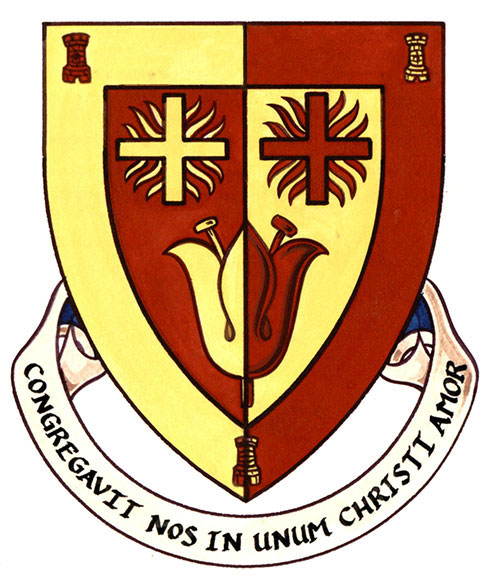
Arms of the Federation of the Sisters of St. Joseph of Canada for use by the Sisters of St. Joseph of the Diocese of London in OntarioBlazonPer pale Gules and Or a lily slipped, in chief two crosses couped and rayonnant, all within a bordure charged with three towers counterchanged; SymbolismThe lily has long been used as a symbol for St. Joseph. The yellow cross represents Christian education and the red cross represents the apostolate of the sick, the two principal mandates of the Federation. The flames surrounding the crosses allude to the Holy Spirit. Red represents Canada, while yellow is a colour associated with the Papacy. The London congregation of the Federation is distinguished by the towers, which are inspired by the tower of the motherhouse in London, England, and by the fact that one of the titles of the Virgin Mary is the “Tower of Ivory.” |
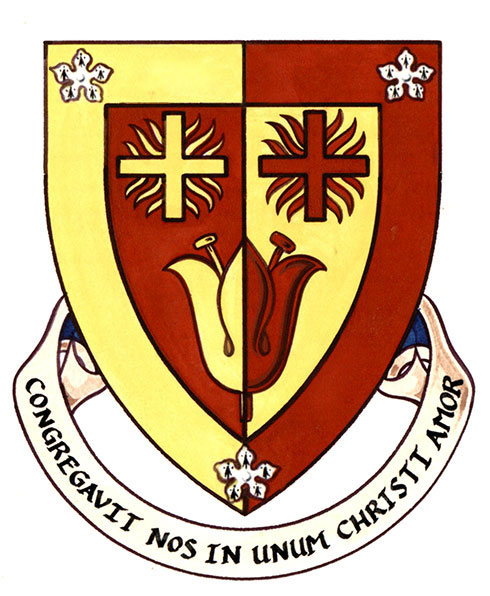
Arms of the Federation of the Sisters of St. Joseph of Canada for use by the Sisters of St. Joseph of the Diocese of HamiltonBlazonPer pale Gules and Or a lily slipped, in chief two crosses couped and rayonnant, all within a bordure counterchanged charged with three fraises Ermine; SymbolismThe lily has long been used as a symbol for St. Joseph. The yellow cross represents Christian education and the red cross represents the apostolate of the sick, the two principal mandates of the Federation. The flames surrounding the crosses allude to the Holy Spirit. Red represents Canada, while yellow is a colour associated with the Papacy. The Hamilton congregation of the Federation is distinguished by the ermine fraise, or strawberry flower, a symbol associated with the Scottish name Hamilton. |
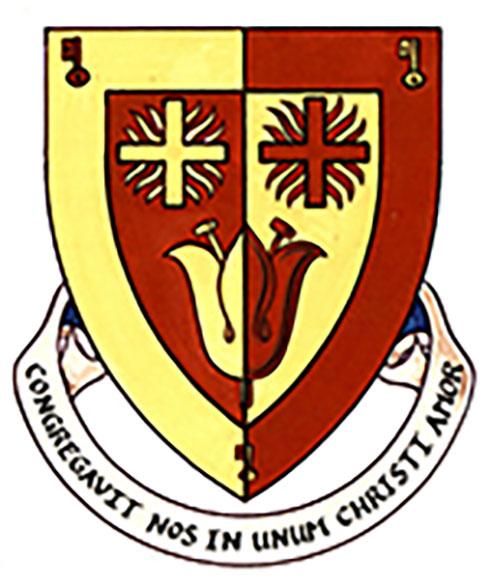
Arms of the Federation of the Sisters of St. Joseph of Canada for use by the Sisters of St. Joseph of the Diocese of Peterborough in OntarioBlazonPer pale Gules and Or a lily slipped, in chief two crosses couped and rayonnant, all within a bordure charged with three keys counterchanged; SymbolismThe lily has long been used as a symbol for St. Joseph. The yellow cross represents Christian education and the red cross represents the apostolate of the sick, the two principal mandates of the Federation. The flames surrounding the crosses allude to the Holy Spirit. Red represents Canada, while yellow is a colour associated with the Papacy. The Peterborough congregation of the Federation is distinguished by the keys, emblematic of St. Peter, the patron saint of the cathedral of the diocese. |
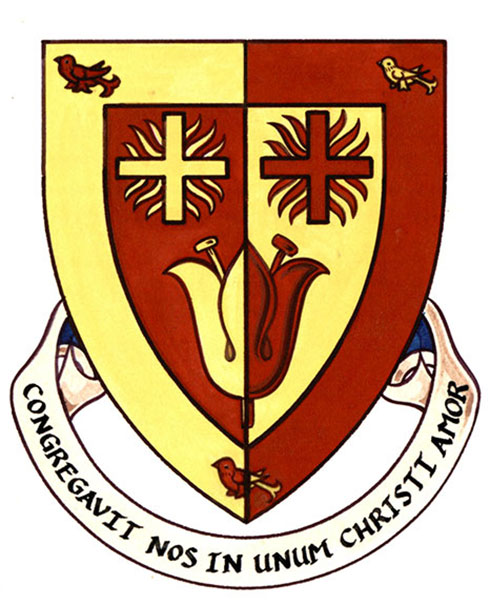
Arms of the Federation of the Sisters of St. Joseph of Canada for use by the Sisters of St. Joseph for the Diocese of Pembroke in CanadaBlazonPer pale Gules and Or a lily slipped, in chief two crosses couped and rayonnant, all within a bordure charged with three martlets counterchanged; SymbolismThe lily has long been used as a symbol for St. Joseph. The yellow cross represents Christian education and the red cross represents the apostolate of the sick, the two principal mandates of the Federation. The flames surrounding the crosses allude to the Holy Spirit. Red represents Canada, while yellow is a colour associated with the Papacy. The Pembroke congregation of the Federation is distinguished by the martlets, taken from the medieval arms of the earls of Pembroke, after whom the Canadian city was named. In English heraldry, the martlet is a cadency mark for a fourth son, thus marking the fact that the Pembroke congregation was the fourth in Canada. |
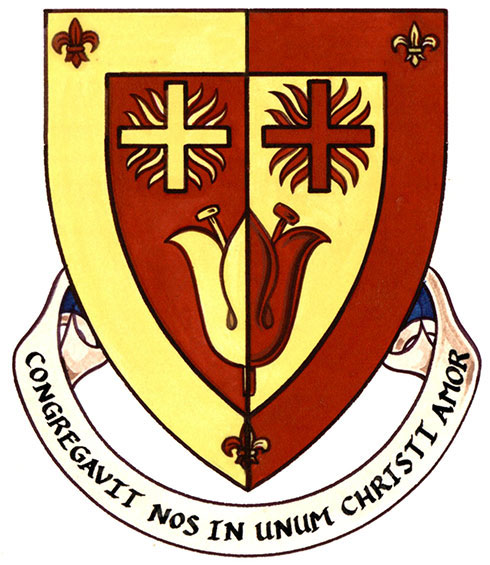
Arms of the Federation of the Sisters of St. Joseph of Canada for use by the Sisters of St. Joseph of Sault Ste. MarieBlazonPer pale Gules and Or a lily slipped, in chief two crosses couped and rayonnant, all within a bordure charged with three fleurs-de-lis counterchanged; SymbolismThe lily has long been used as a symbol for St. Joseph. The yellow cross represents Christian education and the red cross represents the apostolate of the sick, the two principal mandates of the Federation. The flames surrounding the crosses allude to the Holy Spirit. Red represents Canada, while yellow is a colour associated with the Papacy. The Sault Ste. Marie congregation of the Federation is distinguished by the fleur-de-lis, associated with the Virgin Mary. In English heraldry, the fleur-de-lis is a cadency mark for a sixth son, thus marking the fact that the Sault Ste. Marie congregation was the sixth in Canada. |
BackgroundCanada Gazette InformationSince 2023, grants, registrations and approvals of heraldic emblems are no longer announced in the Canada Gazette.   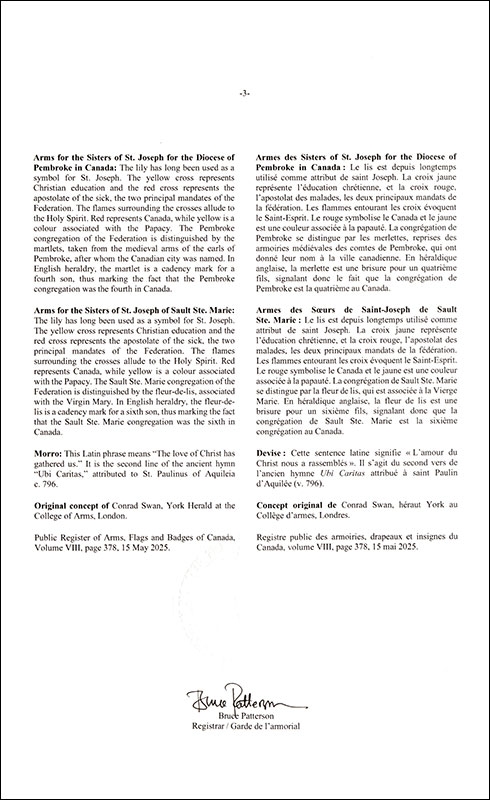 |
Additional InformationCreator(s)Original concept of the College of Arms, London. PainterArtist of the College of Arms, London / Artiste du Collège d’armes, Londres CalligrapherNot available Recipient TypeCivil Institution Other InformationThe recipient’s emblems were originally recorded at the College of Arms, London, England, 13 September 1969. |