
The contents of this Register are intended for research purposes only. The heraldic emblems found in the Register may not be reproduced in any form or in any media without the written consent of the Canadian Heraldic Authority and/or the recipient.
Prince George, British Columbia
Grant of Arms, Flag and Badge
April 15, 2025
Vol. VIII, p. 373

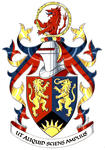
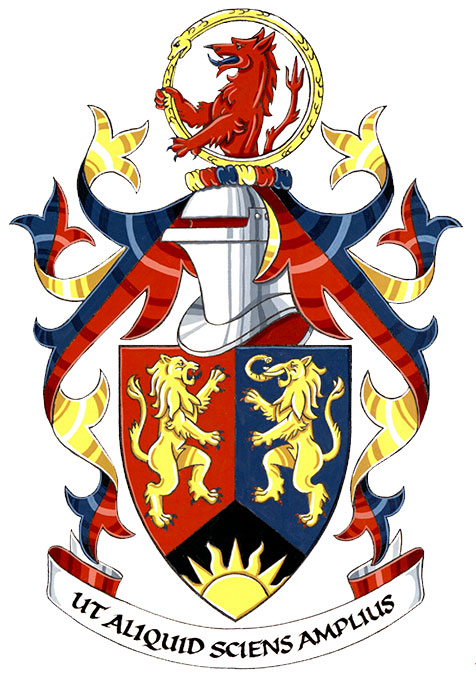
Arms of Dinesh Kumar RamooBlazonTierced in pairle reversed Gules, Azure and Sable, a lion and a gaja-vyala combatant, issuant in base a sun in splendour Or; SymbolismRed and black are the colours of the soil in the Tamil tradition, while blue represents the rivers of Dr. Ramoo’s ancestral homeland in southern India and Sri Lanka (his birthplace). The lion is common to the coats of arms of England and Canada, where Dr. Ramoo obtained his doctorate and where he now lives, respectively. Meanwhile, the gaja-vyala or yali, which is represented here with the body of a lion and the trunk and tusks of an elephant, is a mythical creature in Tamil culture. Taken together, they embody his lands of birth, study and residence. The sun is a canting reference to his first name, Dinesh, which translates to “Lord of the day” or simply “Sun.” It also figures prominently in the coat of arms of British Columbia, his province of residence. |
CrestBlazonA demi-tyger, its tail ending in a trident Gules, holding and environed by an ouroboros Or; SymbolismIn Tamil culture, the tiger is a symbol of honour. Its trident-shaped tail alludes to Dr. Ramoo’s academic career in psychology, which uses the Greek letter psi (shaped liked a trident) as its symbol. As the stylized heraldic “tyger” reflects the lack of familiarity with actual tigers in medieval Europe, its use here represents Dr. Ramoo’s efforts to overcome the gaps in knowledge about other communities in modern psychology. The ouroboros represents the meaning of one of the historical names for Madurai, his ancestral city in south India, which is based on the name of a serpent sent by Lord Siva to denote the city’s boundaries. |
MottoBlazonUT ALIQUID SCIENS AMPLIUS; SymbolismThis Latin expression, meaning “In order that I may know something more,” is taken from a saying in Ammianus Marcellinus’ Res gestae (28.4), “In order that I may know something more before I die.” This encapsulates Dr. Ramoo’s profession as an academic who is continually searching for knowledge and wisdom. |
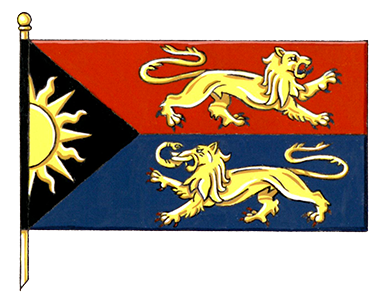
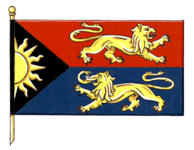
Flag of Dinesh Kumar RamooBlazonPer fess Gules and Azure in chief a lion passant contourné and in base a gaja-vyala passant Or, in hoist on a square flaunch Sable a sun in splendour issuant from the hoist Or; SymbolismThe symbolism of this emblem is found in other element(s) of this record. |
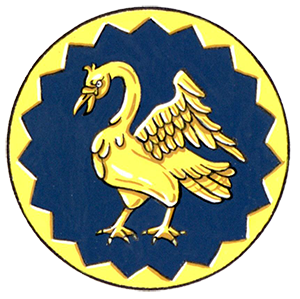
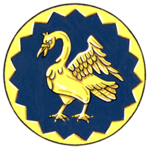
Badge of Dinesh Kumar RamooBlazonA hurt charged with a hamsa wings addorsed and inverted, all within a bordure dancetty Or; SymbolismThe sun motif repeats the symbolism of the Arms. The hamsa, which is often depicted resembling a swan, is a migratory bird of unspecified origin that frequently appears in Indian culture and Hindu iconography. Taken together, the beasts in Dr. Ramoo’s heraldic emblems symbolize the four cardinal virtues in Tamil culture: the lion for arivu, or intelligence; the hamsa for nirai, or knowledge of good and evil; the gaja-vyala or yali for ōrppu, or inquisitiveness; and the tiger for kaṭaipiṭi, or discipline. |
BackgroundCanada Gazette InformationSince 2023, grants, registrations and approvals of heraldic emblems are no longer announced in the Canada Gazette. 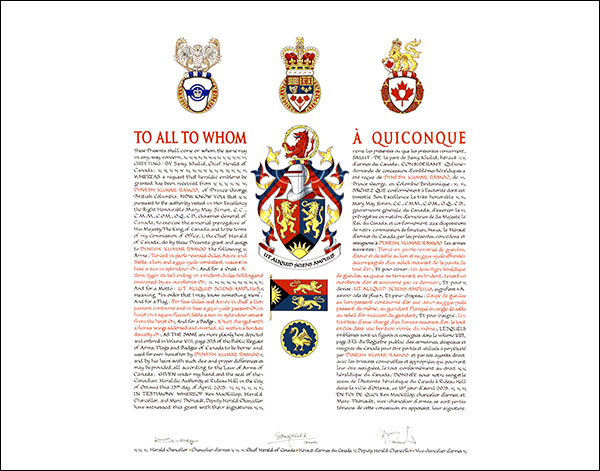 |
Additional InformationCreator(s)Original concept of Dinesh Kumar Ramoo and Alix Chartrand, Saguenay Herald, assisted by the heralds of the Canadian Heraldic Authority. PainterPalina Klimava CalligrapherYolande Lessard Recipient TypeIndividual |