
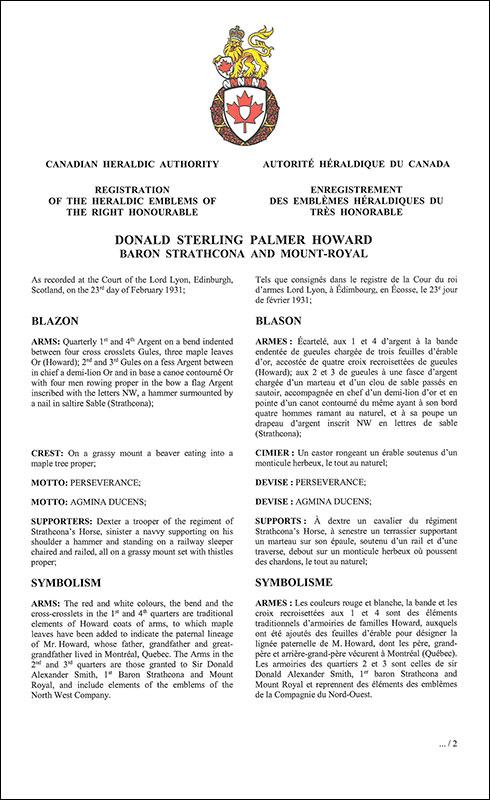
 Arms of Donald Sterling Palmer Howard
Arms of Donald Sterling Palmer Howard
Blazon
Quarterly 1st and 4th Argent on a bend indented between four cross crosslets Gules, three maple leaves Or (Howard); 2nd and 3rd Gules on a fess Argent between in chief a demi-lion Or and in base a canoe contourné Or with four men rowing proper in the bow a flag Argent inscribed with the letters NW, a hammer surmounted by a nail in saltire Sable (Strathcona);
Symbolism
The red and white colours, the bend and the cross-crosslets in the 1st and 4th quarters are traditional elements of Howard coats of arms, to which maple leaves have been added to indicate the paternal lineage of Mr. Howard, whose father, grandfather and great-grandfather lived in Montréal, Quebec. The Arms in the 2nd and 3rd quarters are those granted to Sir Donald Alexander Smith, 1st Baron Strathcona and Mount Royal, and include elements of the emblems of the North West Company.
Crest of Donald Sterling Palmer Howard
Blazon
On a grassy mount a beaver eating into a maple tree proper;
Symbolism
This is the Crest of Sir Donald Alexander Smith, 1st Baron Strathcona and Mount Royal, which includes elements of the emblems of the North West Company.
Motto of Donald Sterling Palmer Howard
Blazon
PERSEVERANCE;
Symbolism
PERSEVERANCE is the Motto of Sir Donald Alexander Smith, 1st Baron Strathcona and Mount Royal, and of the North West Company.
Motto of Donald Sterling Palmer Howard
Blazon
AGMINA DUCENS;
Symbolism
This Latin phrase meaning “In the vanguard” is the Motto of Sir Donald Alexander Smith, 1st Baron Strathcona and Mount Royal.
Supporters of Donald Sterling Palmer Howard
Blazon
Dexter a trooper of the regiment of Strathcona’s Horse, sinister a navvy supporting on his shoulder a hammer and standing on a railway sleeper chaired and railed, all on a grassy mount set with thistles proper;
Symbolism
The Supporters are those of Sir Donald Alexander Smith, 1st Baron Strathcona and Mount Royal. They represent his Regiment, the Lord Strathcona’s Horse (Royal Canadians), and the construction of the Canadian Pacific Railway, whose progress was linked to his financial backing, a fact highlighted by his invitation to drive the Last Spike when the railway was completed in 1885.
