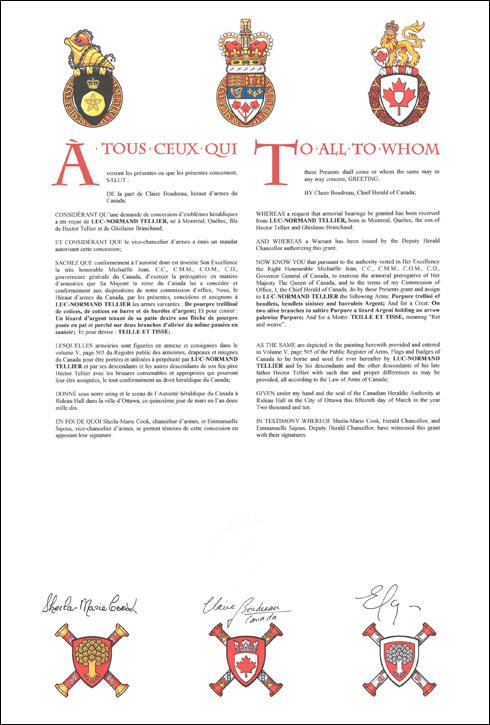
Arms of Luc-Normand Tellier
Arms of Luc-Normand Tellier
Blazon
Purpure trellisé of bendlets, bendlets sinister and barrulets Argent;
Symbolism
Mr. Tellier chose purple, the traditional colour used for dignity, to celebrate the oldest current branch of his family, descended from Joseph, son of Charles and grandson of Pierre-François Le Tellier and Marie Anne Leroux, married in Quebec City in 1700. It was also chosen in honour of his ancestors, Catherine de Baillon and Anne Leneuf du Hérisson. The lattice pattern is a reference to Mr. Tellier’s name, which derives from “teilleurs,” the labourers who separated hemp and linen to extract their woody fibres. The lattice also recalls a hemp canvas, known to be very resilient. The stitches’ hexagonal shape is a symbolic representation of Mr. Tellier’s profession as a specialist in spatial economics.
Crest of Luc-Normand Tellier
Blazon
On two olive branches in saltire Purpure a lizard Argent holding an arrow palewise Purpure;
Symbolism
The lizard is taken from the coat of arms of François Michel Le Tellier de Louvois (1641-1691), Secretary of State under Louis XIV, whose biography Mr. Tellier has written. It also represents Africa, where Mr. Tellier lived as a young man and to which he has returned on a number of occasions. The arrow (flèche in French) represents the surname of his grandmother, Juliette Richer de Laflèche. The two olive branches (olivier in French) recall the first names of his paternal great-grandfathers, both named Olivier Tellier, and the surname of his mother, Ghislaine Branchaud.
Motto of Luc-Normand Tellier
Blazon
TEILLE ET TISSE;
Symbolism
Meaning “Ret and weave”, the motto is another reference to Mr. Tellier’s name and signifies that we must extract what is essential to create something new.