 Arms of the Ville de Huntingdon
Arms of the Ville de Huntingdon
Blazon
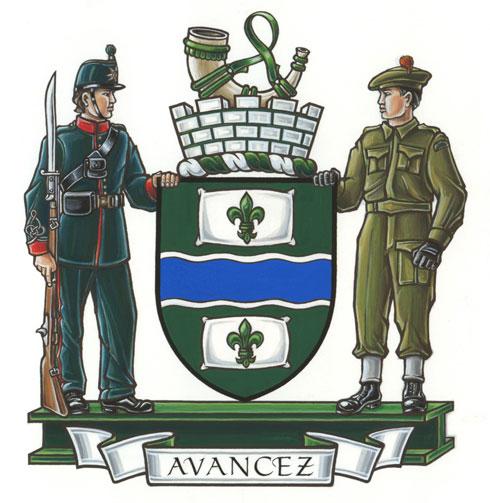
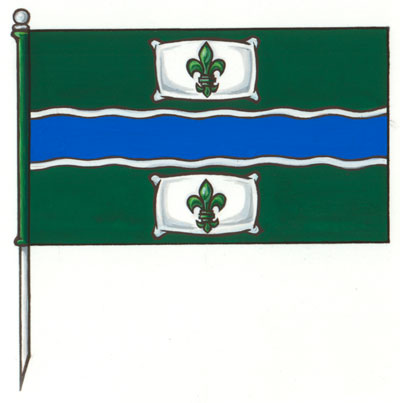
Vert a fess wavy Azure edged Argent between two wool sacks Argent each charged with a fleur-de-lis Vert;
Symbolism
The green represents the agricultural lands of the Chateauguay Valley and the Irish heritage of Huntingdon. The blue wavy band symbolizes the Chateauguay River, which divides the town in two. The wool sacks on either side of the wavy band represent the wool and weaving industries in Huntingdon. The fleurs-de-lis stand for the heritage of the Francophone and Anglophone communities as fleurs-de-lis appear in the arms of the Kingdom of France, the arms and flag of Quebec, and the arms of the former Borough of Huntingdon and Godmanchester in England.
Crest of the Ville de Huntingdon
Blazon
A hunting horn Argent virolled and stringed Vert issuant from a mural crown Argent masoned Vert;
Symbolism
The mural crown represents civic authority. Huntingdon was the location of the county court and is still the seat of the Municipalité régionale de comté du Haut-Saint-Laurent. The hunting horn is a reference to the name and also to the arms of the English Borough of Huntingdon and Godmanchester.
Motto of the Ville de Huntingdon
Blazon
AVANCEZ;
Symbolism
AVANCEZ, meaning “Advance,” is a military command well known to all francophone soldiers. Here it evokes the economic and social progress of the town.
Supporters of the Ville de Huntingdon
Blazon
Dexter a rifleman of the Rifle Brigade tempore 1870, sinister a private of the Black Watch (Royal Highland Regiment of Canada) tempore 1940, standing on a girder Vert;
Symbolism
The soldier of the Rifle Brigade evokes the Fenian Raids of 1866 and 1870, when troops from the Montreal Garrison joined with the local militia, the Huntingdon Borderers, to face invaders from New York State. It also honours Prince Arthur (later, the Duke of Connaught), the third son of Queen Victoria, who was a lieutenant in the Rifle Brigade stationed in Montreal in 1870. He came to Huntingdon to congratulate local soldiers shortly after their victory at Trout River, and returned some 50 years later, after having served as Governor General of Canada.
The soldier of the Black Watch (Royal Highland Regiment of Canada) refers to the creation of an army camp in Huntingdon during the Second World War, at which officers and NCOs from that regiment formed the initial training cadres. As a result, the Black Watch was accorded the freedom of the city of Huntingdon. The green beam evokes the Walker Bridge, which has long united Huntingdon and the Townships of Godmanchester and Hinchinbrooke.

