
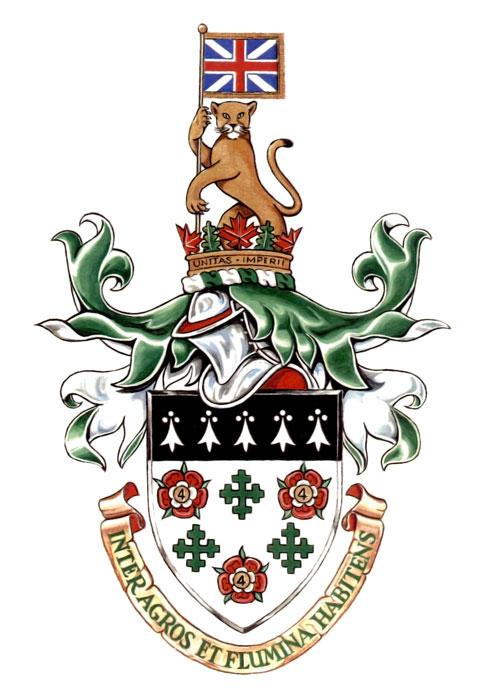
 Arms of the Village of Westfield
Arms of the Village of Westfield
Blazon
Argent three cross-crosslets Vert chevronwise between as many Tudor roses seeded Or two and one displaying the numeral 4 Sable a chief of five spots ermines;
Symbolism
The cross-crosslets are derived from the arms of John Coffin (ca. 1751-1838), a Loyalist General from Massachusetts who had settled in Westfield and became an influential businessman and politician. Green alludes to the village’s rural setting. The Tudor rose charged with the numeral 4 is the badge used on tunic buttons of the King’s 4th American Regiment in which both John Coffin and Henry Nase of New York (ca. 1748-1834) served. The latter was the first Loyalist settler in Westfield. The upper section with ermine tails symbolizes the seigneury de Martignon of the Acadian fur-trader Martin d’Aprendestiguy, which included the Westfield area.
Crest of the Village of Westfield
Blazon
Issuing out of a Loyalist Civil Coronet (rim Or, maple leaves Gules, oak leaves Vert, letters Sable) an Eastern Panther (Felis Concolor cougar, Kerr) rampant guardant Or ears and tail-tip Sable holding in its forepaws a flagstaff Argent flying therefrom to the sinister the Union Flag of 1707 fringed Or;
Symbolism
The Eastern panther is seen occasionally in the Westfield area. The Union Flag of 1707 is the flag under which the Loyalists fought. The Loyalist Civil Coronet includes maple leaves for Canada and oak leaves as a Royal plant badge. The frieze is inscribed with “UNITAS IMPERII,” meaning “Unity of the Empire.”
Motto of the Village of Westfield
Blazon
INTER AGROS ET FLUMINA HABITANS. This Latin phrase means "Settled among the fields and the rivers".
Symbolism
This Latin phrase meaning “Settled among the fields and rivers” describes Westfield’s rural setting.
