Home > Role > Constitutional Duties
Constitutional Duties
-
Installation Ceremony
October 1, 2010
-
The Queen’s Corbel
December 9, 2010
-
Royal Assent
December 15, 2010
-
Swearing-in Ceremony
January 4, 2011
-
Diamond Jubilee Medal
February 3, 2011
-
Royal Wedding Coins
April 6, 2011
-
Royal Wedding Commemorative Stamps
April 15, 2011
-
Royal Wedding
April 26, 2011
-
Visit to London
April 27, 2011
-
Visit to London
April 28, 2011
-
Royal Wedding Ceremony
April 29, 2011
-
Swearing-In Ceremony
May 18, 2011
-
Speech from the Throne
June 3, 2011
-
National Aboriginal Day
June 21, 2011
-
2011 Royal Tour
June 21, 2011
-
Canadian Sunset Ceremonies
June 22, 2011
-
Official Welcoming Ceremony
June 30, 2011
-
2011 Canada Day
July 1, 2011
-
Ceremonial Tree Planting
July 2, 2011
-
Government of Canada Reception
July 7, 2011
-
Farewell to Their Royal Highnesses
July 8, 2011
-
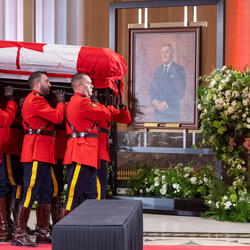
Lying-in-State
August 24, 2011
-
State Funeral for Jack Layton
August 27, 2011
-
Diamond Jubilee Medal
December 6, 2011
-
Diamond Jubilee Stamps
January 16, 2012
-
Crown-First Nations Gathering
January 24, 2012
-
Diamond Jubilee Medal
February 6, 2012
-
Diamond Jubilee Window
February 7, 2012
-
Diamond Jubilee Gala Dinner
May 12, 2012
-
Royal Tour 2012 - Welcome
May 21, 2012
-
Royal Tour 2012 - Farewell
May 23, 2012
-
Queen's Diamond Jubilee - Day 1
June 3, 2012
-
Queen's Diamond Jubilee - Day 2
June 4, 2012
-
Queen's Diamond Jubilee - Day 3
June 5, 2012
-
Queen's Diamond Jubilee - Day 4
June 6, 2012
-
National Aboriginal Day
June 20, 2012
-
Lieutenant Governors' Conference
June 27, 2012
-
Diamond Jubilee at Rideau Hall
June 28, 2012
-
Screening of The Portrait
September 24, 2012
-
Meeting with Ms. Judith Guichon
October 1, 2012
-
Inter-Parliamentary Union
October 21, 2012
-
National Recognition Ceremony
October 25, 2012
-
State Funeral for Lincoln Alexander
October 26, 2012
-
Royal Assent
December 14, 2012
-
Diamond Jubilee Park in Ottawa
December 18, 2012
-
Ceremonial Meeting
January 11, 2013
-
Diamond Jubilee Medal
January 26, 2013
-
Courtesy Call
February 1, 2013
-
Diamond Jubilee Medal Presentation
February 6, 2013
-
Governor-General of Australia
April 4, 2013
-
Postage Stamp Unveiling
May 8, 2013
Canada is a constitutional monarchy, where the duties of head of State and head of Government are distinct. Canada’s Parliament consists of three parts: the Queen, represented by the governor general; the Senate; and the House of Commons.
The Letters Patent Constituting the Office of the Governor General and Commander-in-Chief of Canada (1947) authorize the governor general of Canada to exercise powers and responsibilities belonging to the Sovereign, with the advice of members of the Privy Council. The governor general is non-partisan and apolitical.
The Canadian Constitution Act (1867) places executive power in the Queen. However, in practice this power is exercised by the prime minister and his ministers. The governor general acts on the advice of the prime minister and the government, but has the right to advise, to encourage and to warn. As such, the governor general can offer valued counsel to the head of Government.
One of the governor general’s most important responsibilities is to ensure that Canada always has a prime minister and a government in place that has the confidence of Parliament. In addition, the governor general holds certain reserve powers, which are exercised at his or her own discretion. The governor general also presides over the swearing-in of the prime minister, the chief justice of Canada and cabinet ministers. It is the governor general who summons, prorogues and dissolves Parliament, who delivers the Speech from the Throne, and who gives Royal Assent to acts of Parliament. The governor general signs official documents and regularly meets with the prime minister.